![[personal profile]](https://www.dreamwidth.org/img/silk/identity/user.png)
Someone posted a pic on Tumblr featuring the weird-ass character designs for Mandalorians in TCW. I have some Theories about why their visual design in the show is so jarring:

I have a theory about this, which I'm sticking under the cut, cus it's long:
HOkay. SO.
719 years before the rise of the Empire: The Mandalorian Excision.
Mandalore is doing well – great, actually, they’ve never been more productive and they’ve just opened a few new beskar mines. The settlements on the moon – Concordia – and on Concord Dawn (not to be confused with Concordia) have proven to be self-sufficient. Things are looking up!
Except not quite. Mandalore’s nearest neighbor is Kalevala. They’re absolutely terrified of Mandalore going on the warpath again; Kalevala’s likely sent spies to investigate Mandalore’s status. What they find is deeply concerning.
Kalevala goes to the Republic – specifically the Jedi – for assistance. If Mandalore starts conquering again, Kalevala thinks it’ll be the first target on the list. They’re probably not wrong, either. The Jedi and the Mando'ade do not have a fantastic history between them; the Jedi’s response is to nip Mandalorian growth in the bud.
The Republic invades Mandalorian space. Technically illegally, but history is written by the victors.

Parts of Concord Dawn and other Mandalorian-held worlds suffer catastrophic bombardment during the fighting, but Mandalore is hit the hardest: half the planet is literally glassed before the end. What’s left when the surface cools is a scintillating crystal desert on the southern half of Mandalore, the sand utterly useless for industrial applications without extensive processing. Even the untouched northern half of the planet suffers ecologically as the seas boil off. The planet spends months wracked by deadly weather systems caused by the complete disruption of the existing balance.
The Republic then blockades the sector and occupies it, installing their own government to manage things. The Mando’ade are forced to conceal all outward connections to the Resol’nare: no armour, no weapons, no overt training
Beskar being as resilient as it is, the southern mines have been sealed at ground level, but below the surface are relatively intact. The Mando’ade try to rebuild, but it’s a tough process when you have no outside trade coming in and a hostile power literally controlling what you can and cannot do with your own planet. It’s also physically dangerous – inhaling glass dust can lead to silicosis and other diseases, as well as any of the compounds in the dust which might be carcinogenic. A huge portion of the southern continent had been used for industry, after all. And with half the planet’s lush farmland slagged, they can’t locally support the work.
Maybe it started as altruism; maybe it was always the plan.
Kalevala offers assistance in rebuilding. The Republic lets them, because hey, Kalevala was the one that lit this off in the first place. Maybe they feel a little regret? The glass-dust sand is bad for everything – machines, droids, and people alike – so they start with force fields and then transparisteel domes that also regulate their internal climate. Kalevala starts by building on top of the southern beskar mine access points and drilling through the melted bedrock, so the material to rebuild can be collected without risking going out on the desert. They bring in extra help from Kalevala. It takes a couple decades to get the dome cities to the point where they can operate without direct assistance from offworld.
The Republic offers no direct assistance during the Reconstruction, but it’s pretty clear who they’re favoring. When they finally back out of Mandalorian space, it’s a Kalevalan regent they leave in charge.
By this point, the Kalevalans who arrived to assist in the reconstruction have settled. Families have been started. The domes are designed for comfort, and with the beskar mines now functioning as commercial sources, there’s a financial boom that promises to have the population living well.
Somehow, those proceeds never make it to the northern half of Mandalore. Some of the survivors warned against cooperating with the Kalevalans, and others kept reminding the people set on restoring the south that the Mando'ade don’t need a planet in order to have a home: they can have the Resol'nare again, for which these outsiders have no understanding nor respect.

The largest dome in the south, Sundari, schisms from Keldabe. The northerners have a Mand'alor – or choose a new one, if the previous perished in the Excision (there’s no information either way) – but they don’t understand what it was like to suffer in the desert trying to rebuild – maybe there was a disagreement during the process on how things should be done. Sundari picks its own Mand'alor – one of the Kalevalans who had gained a good reputation during the Reconstruction, someone who at least appreciates the local culture.
They set up a local government that’s similar to what they’re accustomed to on Kalevala – and why shouldn’t they? Their advisors are Kalevalan, and it’s not like the southern population is going to resist the policies of a Mand'alor they elected.
Diplomatic discussions open up with Kalevala. See, they didn’t just provide assistance out of the goodness of their hearts: they expected repayment. Through a combination of politics and trade deals, Mandalore becomes subject to Kalevala; to take the sting off, it’s declared an extension of Kalevalan territory – rather than a colony, which would have much lower political standing – and declared a duchy so the planet has self-determination. The southern Mand'alor gains the title of Duke/Duchess. They’re still elected, but somehow the role never strays far from the hands of Kalevalan political elites.
Again: maybe this was the plan all along, or maybe it was a bunch of rich people being opportunistic. The end result is the same.
Here’s the thing about the Resol’nare: one of the tenets is answering to the Mand’alor. If you don’t follow the Mand’alor, you’re considered dar’manda – no longer Mandalorian. If there’s more than one group with their own Mand’alor, things get… sticky.
Tensions are high between south and north – the New Mandalorians and the True Mandalorians. It’s not really surprising the True Mandalorians would be upset: who are these outsiders to come in here, claim our titles, and then sell our world? In an effort to boost the New Mandalorian population, Kalevala offers opportunities to its citizens to help their Mandalorian territories, and to show the Mando'ade that there’s a better way to live than constant warfare.
If this looks like a classic example of colonization, that’s because it is.
Attempts by the New Mandalorians to subtly colonize the north have only limited success – they can’t prove it was sabotage, but they suspect. The Mando'ade who do go south for whatever reason – extending friendship, joining family, seeking work, accepting offers from the New Mandalorians, whatever – find that their appearance sets them apart. The New Mandalorians are nice about it, but enough social pressure happens that those Mando’ade who can’t afford to leave feel stifled. Dark hair is bleached to fit in, accents are adopted, Mando'a is only spoken at home and isn’t taught in the schools. Mando’ade who aren’t human – and there are many – have a particularly difficult time among the New Mandalorians. The Resol'nare is still kept, but only in the privacy of the home.
AND THEN.
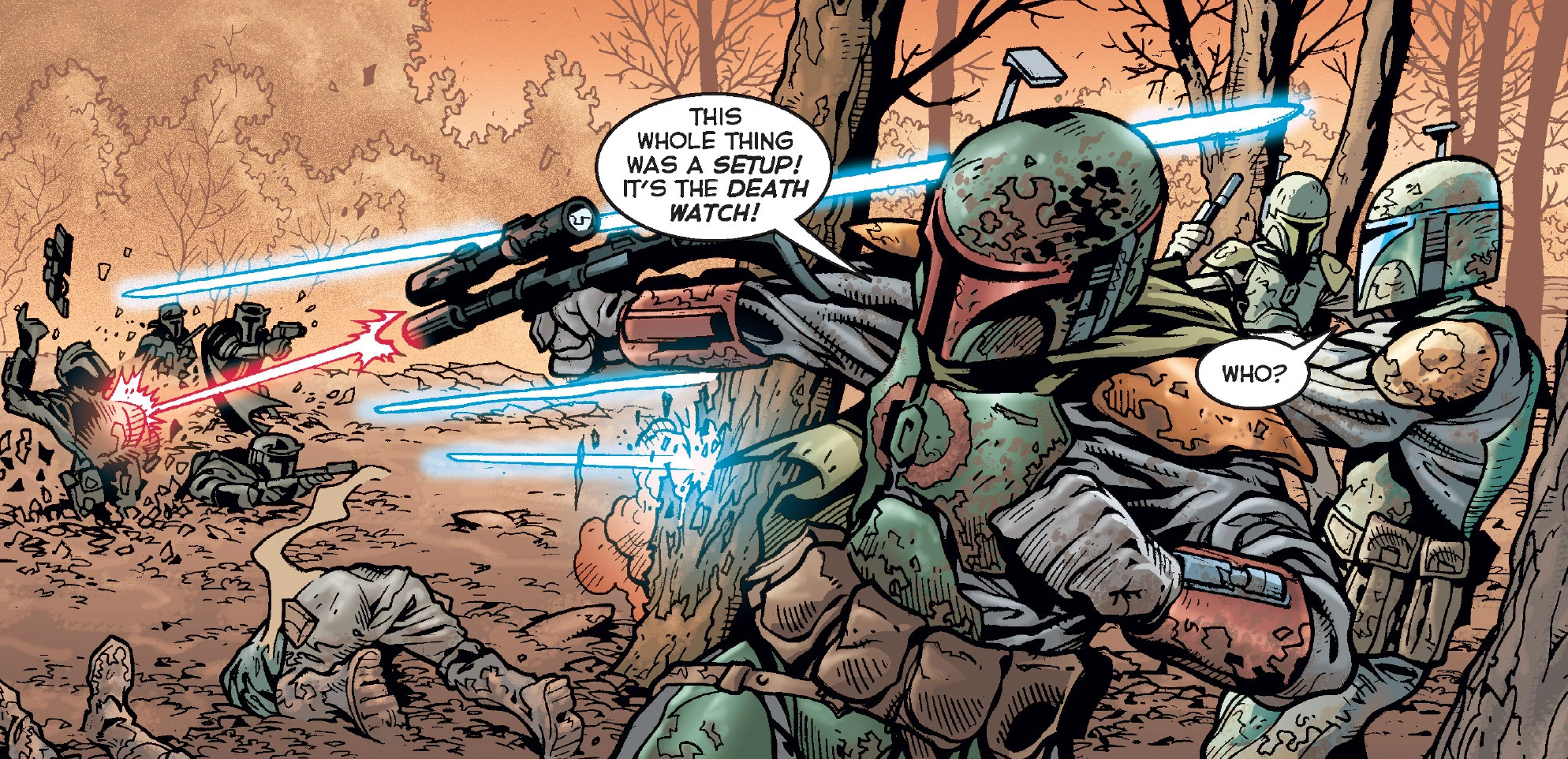
A few hundred years down the line, Mand’alor Jaster Mereel of the True Mandalorians attempts to enact some (overdue and widely demanded) cultural reform. Resistant splinter groups form, most notably Death Watch under the command of Tor Viszla, sparking off the Mandalorian Civil War. Viszla kills Mereel during a battle on Korda Six, leaving Mereel’s adopted son, Jango Fett, to pick up the reins. Death Watch arranges for an ambush on Galidraan that pits True Mandalorians against a detachment of Jedi and ends with Fett being sold into slavery for several years.
With the True Mandalorians scattered, Death Watch turns their attention on the New Mandalorians, who had remained neutral throughout the conflict.
The Duke is assassinated. His teenage daughter, barely old enough to accept the title the New Mandalorians offer her, goes into hiding from Death Watch’s assassins for a year with her Jedi protectors. Traumatized and blaming anything that could be considered a warlike nature, she completely abolishes part of the Resol'nare. No armour, no weapons, no training at all. Those who protest are offered a shuttle to Concordia or Concord Dawn – not sending them back north to bolster the decimated ranks of the True Mandalorians. She would clear the True Mandalorians off the north entirely if she could, but achieving that would require the type of violence she abhors.
Dipping into the meta for a moment: any visual designs are a deliberate choice by the creators. Even in other cultures in TCW where there’s a level of uniformity, there are defined genetic differences in hair colour (not going to get into how everyone’s clothes always use the same palette, because that’s done for a different reason). Satine’s blond hair is noticeably a more natural shade; the bright yellow or “brassy” colour seen on a lot of civilians is the result of a bleach job that hasn’t removed all the natural tint, either by choice or by accident. This is a deliberate artistic choice and the creators are trying to tell the audience something about the culture. There’s no reason for that to be the case unless there’s social pressure behind it to maintain a certain appearance. Particularly since – one would assume – Death Watch still maintains the acceptance of non-human species into their ranks, conformity of appearance both expresses the New Mandalorians’ passive resistance to their enemy and internal support for their culture.
It’s worth noting that the Excision itself was a plot device introduced to the IP in 2010 specifically as backstory for the show.
Mandalore’s implied recent history is one of colonization and cultural genocide, and you can fight me over it.
I have a theory about this, which I'm sticking under the cut, cus it's long:
HOkay. SO.
719 years before the rise of the Empire: The Mandalorian Excision.
Mandalore is doing well – great, actually, they’ve never been more productive and they’ve just opened a few new beskar mines. The settlements on the moon – Concordia – and on Concord Dawn (not to be confused with Concordia) have proven to be self-sufficient. Things are looking up!
Except not quite. Mandalore’s nearest neighbor is Kalevala. They’re absolutely terrified of Mandalore going on the warpath again; Kalevala’s likely sent spies to investigate Mandalore’s status. What they find is deeply concerning.
Kalevala goes to the Republic – specifically the Jedi – for assistance. If Mandalore starts conquering again, Kalevala thinks it’ll be the first target on the list. They’re probably not wrong, either. The Jedi and the Mando'ade do not have a fantastic history between them; the Jedi’s response is to nip Mandalorian growth in the bud.
The Republic invades Mandalorian space. Technically illegally, but history is written by the victors.
Parts of Concord Dawn and other Mandalorian-held worlds suffer catastrophic bombardment during the fighting, but Mandalore is hit the hardest: half the planet is literally glassed before the end. What’s left when the surface cools is a scintillating crystal desert on the southern half of Mandalore, the sand utterly useless for industrial applications without extensive processing. Even the untouched northern half of the planet suffers ecologically as the seas boil off. The planet spends months wracked by deadly weather systems caused by the complete disruption of the existing balance.
The Republic then blockades the sector and occupies it, installing their own government to manage things. The Mando’ade are forced to conceal all outward connections to the Resol’nare: no armour, no weapons, no overt training
Beskar being as resilient as it is, the southern mines have been sealed at ground level, but below the surface are relatively intact. The Mando’ade try to rebuild, but it’s a tough process when you have no outside trade coming in and a hostile power literally controlling what you can and cannot do with your own planet. It’s also physically dangerous – inhaling glass dust can lead to silicosis and other diseases, as well as any of the compounds in the dust which might be carcinogenic. A huge portion of the southern continent had been used for industry, after all. And with half the planet’s lush farmland slagged, they can’t locally support the work.
Maybe it started as altruism; maybe it was always the plan.
Kalevala offers assistance in rebuilding. The Republic lets them, because hey, Kalevala was the one that lit this off in the first place. Maybe they feel a little regret? The glass-dust sand is bad for everything – machines, droids, and people alike – so they start with force fields and then transparisteel domes that also regulate their internal climate. Kalevala starts by building on top of the southern beskar mine access points and drilling through the melted bedrock, so the material to rebuild can be collected without risking going out on the desert. They bring in extra help from Kalevala. It takes a couple decades to get the dome cities to the point where they can operate without direct assistance from offworld.
The Republic offers no direct assistance during the Reconstruction, but it’s pretty clear who they’re favoring. When they finally back out of Mandalorian space, it’s a Kalevalan regent they leave in charge.
By this point, the Kalevalans who arrived to assist in the reconstruction have settled. Families have been started. The domes are designed for comfort, and with the beskar mines now functioning as commercial sources, there’s a financial boom that promises to have the population living well.
Somehow, those proceeds never make it to the northern half of Mandalore. Some of the survivors warned against cooperating with the Kalevalans, and others kept reminding the people set on restoring the south that the Mando'ade don’t need a planet in order to have a home: they can have the Resol'nare again, for which these outsiders have no understanding nor respect.
The largest dome in the south, Sundari, schisms from Keldabe. The northerners have a Mand'alor – or choose a new one, if the previous perished in the Excision (there’s no information either way) – but they don’t understand what it was like to suffer in the desert trying to rebuild – maybe there was a disagreement during the process on how things should be done. Sundari picks its own Mand'alor – one of the Kalevalans who had gained a good reputation during the Reconstruction, someone who at least appreciates the local culture.
They set up a local government that’s similar to what they’re accustomed to on Kalevala – and why shouldn’t they? Their advisors are Kalevalan, and it’s not like the southern population is going to resist the policies of a Mand'alor they elected.
Diplomatic discussions open up with Kalevala. See, they didn’t just provide assistance out of the goodness of their hearts: they expected repayment. Through a combination of politics and trade deals, Mandalore becomes subject to Kalevala; to take the sting off, it’s declared an extension of Kalevalan territory – rather than a colony, which would have much lower political standing – and declared a duchy so the planet has self-determination. The southern Mand'alor gains the title of Duke/Duchess. They’re still elected, but somehow the role never strays far from the hands of Kalevalan political elites.
Again: maybe this was the plan all along, or maybe it was a bunch of rich people being opportunistic. The end result is the same.
Here’s the thing about the Resol’nare: one of the tenets is answering to the Mand’alor. If you don’t follow the Mand’alor, you’re considered dar’manda – no longer Mandalorian. If there’s more than one group with their own Mand’alor, things get… sticky.
Tensions are high between south and north – the New Mandalorians and the True Mandalorians. It’s not really surprising the True Mandalorians would be upset: who are these outsiders to come in here, claim our titles, and then sell our world? In an effort to boost the New Mandalorian population, Kalevala offers opportunities to its citizens to help their Mandalorian territories, and to show the Mando'ade that there’s a better way to live than constant warfare.
If this looks like a classic example of colonization, that’s because it is.
Attempts by the New Mandalorians to subtly colonize the north have only limited success – they can’t prove it was sabotage, but they suspect. The Mando'ade who do go south for whatever reason – extending friendship, joining family, seeking work, accepting offers from the New Mandalorians, whatever – find that their appearance sets them apart. The New Mandalorians are nice about it, but enough social pressure happens that those Mando’ade who can’t afford to leave feel stifled. Dark hair is bleached to fit in, accents are adopted, Mando'a is only spoken at home and isn’t taught in the schools. Mando’ade who aren’t human – and there are many – have a particularly difficult time among the New Mandalorians. The Resol'nare is still kept, but only in the privacy of the home.
AND THEN.
A few hundred years down the line, Mand’alor Jaster Mereel of the True Mandalorians attempts to enact some (overdue and widely demanded) cultural reform. Resistant splinter groups form, most notably Death Watch under the command of Tor Viszla, sparking off the Mandalorian Civil War. Viszla kills Mereel during a battle on Korda Six, leaving Mereel’s adopted son, Jango Fett, to pick up the reins. Death Watch arranges for an ambush on Galidraan that pits True Mandalorians against a detachment of Jedi and ends with Fett being sold into slavery for several years.
With the True Mandalorians scattered, Death Watch turns their attention on the New Mandalorians, who had remained neutral throughout the conflict.
The Duke is assassinated. His teenage daughter, barely old enough to accept the title the New Mandalorians offer her, goes into hiding from Death Watch’s assassins for a year with her Jedi protectors. Traumatized and blaming anything that could be considered a warlike nature, she completely abolishes part of the Resol'nare. No armour, no weapons, no training at all. Those who protest are offered a shuttle to Concordia or Concord Dawn – not sending them back north to bolster the decimated ranks of the True Mandalorians. She would clear the True Mandalorians off the north entirely if she could, but achieving that would require the type of violence she abhors.
Dipping into the meta for a moment: any visual designs are a deliberate choice by the creators. Even in other cultures in TCW where there’s a level of uniformity, there are defined genetic differences in hair colour (not going to get into how everyone’s clothes always use the same palette, because that’s done for a different reason). Satine’s blond hair is noticeably a more natural shade; the bright yellow or “brassy” colour seen on a lot of civilians is the result of a bleach job that hasn’t removed all the natural tint, either by choice or by accident. This is a deliberate artistic choice and the creators are trying to tell the audience something about the culture. There’s no reason for that to be the case unless there’s social pressure behind it to maintain a certain appearance. Particularly since – one would assume – Death Watch still maintains the acceptance of non-human species into their ranks, conformity of appearance both expresses the New Mandalorians’ passive resistance to their enemy and internal support for their culture.
It’s worth noting that the Excision itself was a plot device introduced to the IP in 2010 specifically as backstory for the show.
Mandalore’s implied recent history is one of colonization and cultural genocide, and you can fight me over it.


